
The pour the whole house sits on
Footings, stem walls and monolithic slabs across Pasco and Hillsborough. House Foundations is on our own Google profile, and it is most of what these trucks do.
Why footings get pumped
A footing trench is a narrow target with rebar cages in it, and it usually runs the whole perimeter of the building plus every interior bearing line. A mixer truck can reach the first stretch nearest the road. Everything else is either a wheelbarrow relay across a rebar grid or a pump.
Placing into a trench by chute also means driving the truck close to the excavation, and a loaded mixer at the edge of a fresh trench in Florida sand is how a wall of that trench ends up in the bottom of it. The pump sits back on firm ground and the concrete comes to the trench instead.
Then there is the cage. Concrete dropped from height through a rebar cage segregates, the aggregate goes one way and the paste goes another, and you end up with honeycombing where the strength was supposed to be. A boom tip placed low and walked along the trench puts the mix in without that.
Monolithic slabs, which is most of Florida
Most of what gets built around Wesley Chapel is a monolithic slab: the footing thickening and the floor slab poured in one continuous placement, with the vapor barrier down and the thickened edges formed in the same operation. It is fast, it works on our soils, and it is completely unforgiving about placement rate.
Continuous means continuous. Once you start, the whole pour has to go before the earlier concrete takes its initial set, or you have a cold joint running through the foundation of the house. On a hot Florida afternoon that clock is shorter than people expect. This is the single strongest argument for a pump on a house slab: it places at a rate that keeps the pour ahead of the set.
Their own listing photo shows exactly this job, a house slab just placed with the boom line still overhead and two finishers on power trowels working it, block already stacked on the pad and a new subdivision behind.
Stem walls, piers and elevated builds
Not every foundation is a slab on grade. On a sloped lot, a flood zone or a coastal parcel the house sits on a stem wall, on piers, or on piles with a grade beam tying them, and every one of those is a pumped pour by default. The forms are tall, narrow and full of steel, and there is no chute geometry that reaches the bottom of a twelve foot column form.
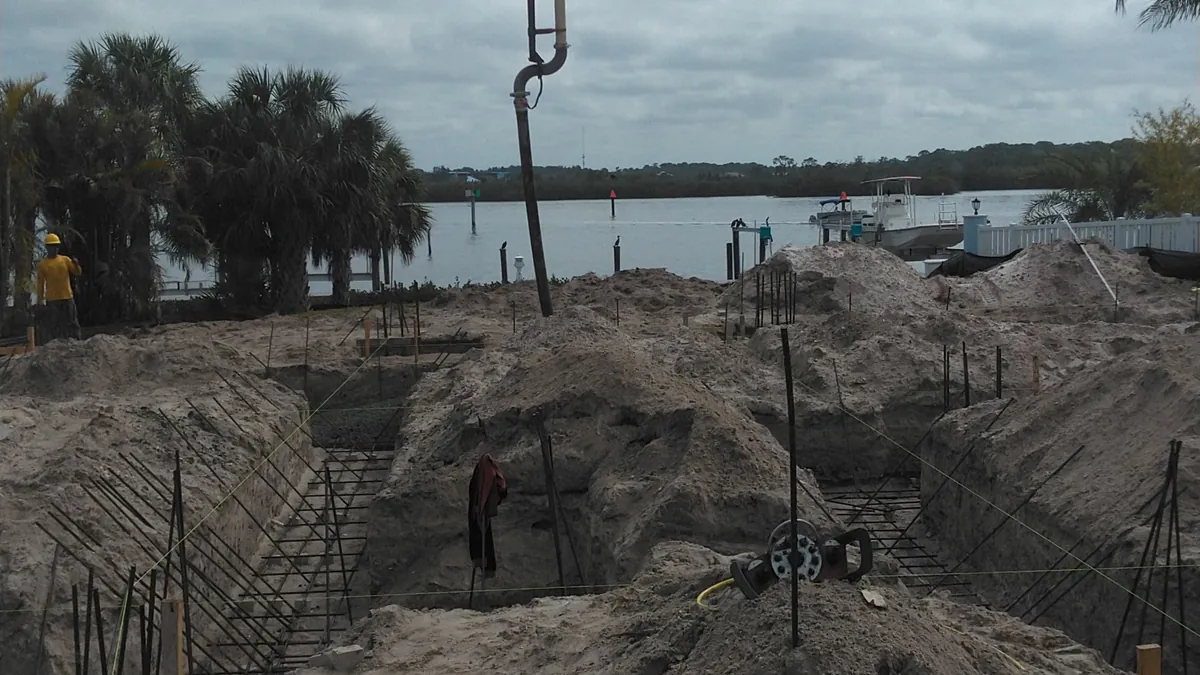
Two of their listing photos are this work. One shows column forms braced with lumber and rebar cages standing in them on a Gulf front lot. The other shows footings dug on a riverfront parcel with the boom pipe coming down into them.
Tall forms also need the concrete placed in lifts and vibrated, not dumped in one go, or the form blows or the concrete arches and leaves a void. The pump makes lift placement practical because the tip can be lowered into the form and raised as it fills.
What the crew needs from you before the day
Where the trucks come in and where they turn around. Where the pump can set up on firm ground with the reach it needs. What is overhead. Whether anything was dug or backfilled recently. Where the washout goes.
None of that takes long, and getting it wrong on the morning costs a lot more than a phone call the week before. Call (813) 991-4544 and walk through it before the concrete is booked.
Not sure this is the work you need?
What 35 homeowners said
Every quote below is a real review, word for word, from our Google profile.
Man, First time using K&R and these guys do it and do it right. Corey and Chris are top notch pump guys that put it in there right. I will only use this company for now on. If I could give 10 stars I would. I been around concrete a long time and these are model employees that you want to represent your company well.
We had a wonderful experience with the crew from K&R. They showed up 30 minutes early, let us know about an issue with our supplier, and talked us through the entire process. They went above and beyond by helping us (first time DIYers) out, giving us advice and tips, and when it started pouring rain they even helped us hoist up the tarp to get the job done. We are so pleased with the service we received and would highly recommend K&R.
We used K&R to pump our house foundation, 50+ yards of concrete. These guys showed up on time and ready to work. They were super nice, and helpful. They jumped right in to lend a hand, going above and beyond what they needed to do. I would highly recommend this company. Its super hard to find good workers these days but these guys are it!
I've been using K and R for 3 years now. And they are my main concrete pumping contractor. Very happy with their work. Always on time
The owners of this business were very outgoing, willing to help out with whatever my needs were and made sure that I was 100% satisfied. Most important, they were the most kind people that I have ever dealt with.
Just want to give a big shout out to Kenny and Rhonda you guys are awesome slab turned out great and all I can say is you guys are always the easiest people to get along with and I really appreciate you guys
Think you have a problem up there? We will look at it, free.
House Foundations is listed as a service on our Google Business Profile, and the pump work is what these three trucks do every day. Tell us what the job actually is on the call and we will tell you plainly which parts we are doing and which parts you need a placing crew for.
More than most crews can finish, which is the point. The operator runs at the rate the finishers can keep up with. What sets the schedule is your crew size and the weather, not the pump.
That is the normal case, not the exception. The truck sets up where it can and the boom does the rest. What decides it is where the truck can park with firm ground and clear air, so send a photo of the approach when you call.
A pour that gets rained on before it sets is a problem for the finish, so the call gets made on the day, usually early. One customer wrote that when it started pouring rain the crew helped them hoist a tarp to get the job done. That is the right instinct, but a heavy afternoon storm is still a reason to move a pour rather than fight it.
We photograph the work and show you. If house foundations & footings is not what you actually need, we say so and quote the work that is.
We cover concrete pumping, house foundations & footings, slabs, pads & flatwork, hard access & waterfront pours, concrete delivery and concrete orders & scheduling. Every one of them has its own page with what is included.
Tell us about the pour.
The date, the yardage and where a truck can park. That is most of what we need to give you a number.